
In-House vs. Outsourced Billing The Wrong Choice Is Costing You More Than You Think
It's not really about cost at all; it's a matter of control, and the majority of practices discover too late which side they really belong to.
01
The Question Everyone Asks Wrong
Practice owners compare the biller's salary with the billing company's fee and consider that to be the end of the matter. It isn't. The real question is simpler and harder to answer: is your billing being run or is it merely being staffed?
A practice can be employing a person to bill full time and yet still end up losing money every week. It is possible for a practice to outsource and yet remain unaware of its own figures. It is not the model that determines your result; it is the way in which it is managed.
02
What Each Model Actually Means
| Billing Model | Definition |
|---|---|
| In-house billing | Means your practice employs its own biller or billing team, usually working inside your EHR or practice management system, handling everything from eligibility checks to claim submission to appeals. |
| Outsourced billing | Means a third-party company, ideally one that specializes in behavioral health, manages some or all of that same cycle on your behalf, typically charging a percentage of what they collect rather than a salary. |
| Hybrid billing | Is the middle version, where a practice keeps front-desk or eligibility tasks in-house and outsources the harder parts, like authorizations, denial appeals, and reporting. Many growing practices land here before moving fully to one side or the other. |
03
What's Quietly Draining Your Revenue Right Now
You don't need a cost comparison to know if your current billing is working. You need to ask yourself a few uncomfortable questions.
- Do you know your denial rate this month, right now, without asking anyone?
- Has an authorization ever expired mid-treatment before anyone caught it?
- If your biller left tomorrow, would your claims keep moving, or stall?
- Do you know how much of your A/R is sitting past 90 days?
- When a claim gets denied, does someone fight it, or does it just get written off?
If on any of these points you had hesitated, then the problem isn't with the model but with the lack of visibility you have.
04
Why Behavioral Health Breaks the Usual Rules
Behavioral health revenue often depends on details that are easy to miss and expensive to discover late: authorization renewals, visit or unit limits, payer-specific documentation requirements, and telehealth billing rules.
This is the part most practices don't find out until a pattern of denials has already cost them months of revenue.

05
DastifyBH Built Around How Behavioral Health Gets Paid
DastifyBH isn't a billing company that in addition deals with behavioral health; rather, it is our focus. Every part of our revenue-cycle process is built around the realities of behavioral health claims: evolving authorization requirements, utilization limits, complex payer rules, and denials that require timely, informed follow-up. That means:
- Authorizations tracked against utilization so upcoming coverage issues are identified before approved visits or units run out.
- Claims reviewed with payer requirements in mind to reduce avoidable errors before submission.
- Denials actively worked to resolution rather than allowed to age without follow-up.
- Clear reporting and real visibility into submitted claims, denials, payments, and outstanding A/R.
- A team supporting your account so billing activity does not pause when one person is unavailable.
06
When In-House Billing Makes Sense
- Your practice has one or two providers with a stable, predictable payer mix
- You already have an experienced billing staff member who understands behavioral health coding and authorization rules specifically
- You want direct, daily oversight of the billing process
- Your claim volume is low enough that a single person or small internal team can realistically keep up
07
When Outsourcing Makes Sense
- Your practice is adding providers, locations, or payer contracts faster than your billing team can absorb
- You're seeing rising denial rates or aging A/R and don't have the internal bandwidth to dig into why
- You bill across multiple behavioral health specialties (therapy, ABA, SUD, telehealth) with different authorization and coding rules for each
- You've had billing staff turnover disrupt cash flow more than once
- You want reporting and visibility you're not currently getting
08
A Simple Way to Decide
If you're still unsure, the decision usually comes down to three questions:
- Do you have someone in-house who is genuinely strong across eligibility, behavioral health coding, authorization tracking, and denial appeals, not just one or two of those?
- Can your current setup absorb a staff departure without your cash flow taking a hit?
- Do you actually know your denial rate and average days in A/R right now, or are you guessing?
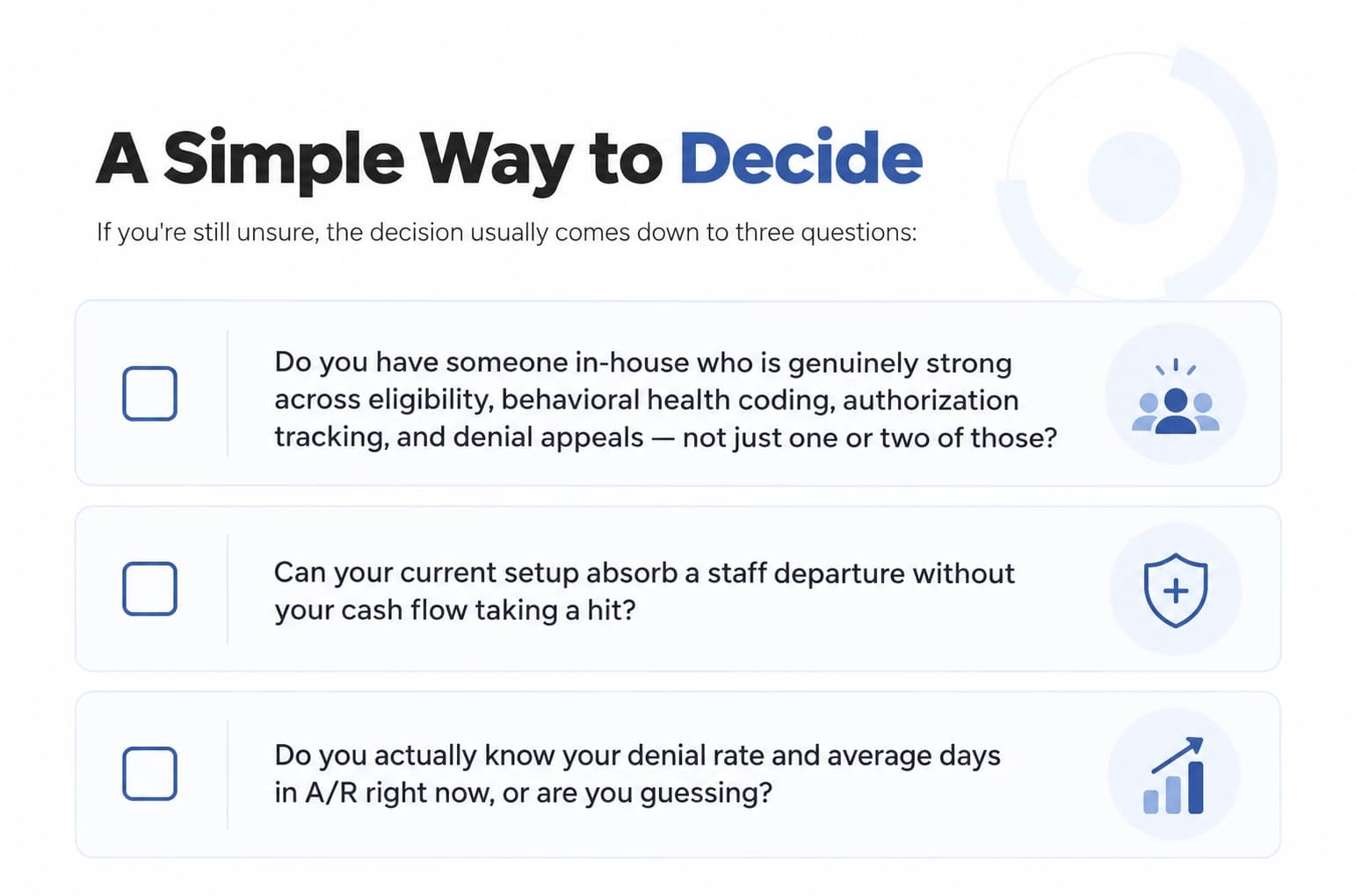
If you answered no to more than one of these, it's worth getting a clear picture of where your billing actually stands before committing further to either model.

Stop Guessing Which Side of This You're On
The Free 90-Day Behavioral Health Billing Audit shows you exactly where your claims, denials, and A/R stand right now, whether you're in-house, outsourced, or somewhere in between.
FAQ’s
Frequently Asked Questions
Not always, and it depends on the comparison. A percentage-based fee can look more expensive than a single salary on paper, but it usually includes a full team, specialized expertise, and ongoing denial follow-up that a single in-house hire can't match at the same cost.
You Don't Need to Guess Anymore
Whether you keep billing in-house, outsource it, or land somewhere in between, the decision should be based on your actual numbers, not a hunch. Let's find out where things really stand.