Psychotherapy CPT Codes Explained: 90832 vs 90834 vs 90837
A therapist wraps up a 55-minute session with a client managing severe PTSD. Clinical notes are detailed. The diagnosis is documented. The treatment plan is on file. Yet the claim comes back denied, or worse, gets quietly downcoded to a lower-reimbursing service because the billing team submitted CPT 90834 instead of 90837. That single digit costs the practice real revenue. This exact scenario plays out in mental health offices across the country every single week.
Getting psychotherapy CPT codes right is not optional. It is the difference between clean claims and a backlog of rejections that drains your cash flow. Whether you run a solo private practice or manage billing for a multi-provider behavioral health group, the three individual psychotherapy codes (90832, 90834, and 90837) form the backbone of your day-to-day revenue cycle.
This guide breaks down each code, exact time thresholds, reimbursement expectations, documentation rules, and the red flags that trigger payer audits.
01
What Are Psychotherapy CPT Codes and Why Do They Matter?
Current Procedural Terminology (CPT) codes are five-digit numbers maintained by the American Medical Association (AMA). Every medical and behavioral health service rendered in the United States maps to a specific CPT code, and psychotherapy is no exception.
For mental health providers, these codes communicate three essential details to insurance payers:
- The service performed (individual psychotherapy in an outpatient or facility setting).
- The exact time spent (face-to-face clinical time with the patient).
- The appropriate reimbursement rate.
Get any of those three elements wrong and the claim stalls. Payers like Medicare, Medicaid, and commercial insurers run automated edits that cross-reference the billed code against session duration, diagnosis complexity, and provider credentials. A mismatch triggers an immediate denial or a request for medical records, delaying payment by weeks or months.
The Centers for Medicare & Medicaid Services (CMS) updates fee schedules annually, and private payer contracts shift just as often. Staying on top of coding rules protects your practice from audits and unnecessary revenue loss.
02
The Three Individual Psychotherapy CPT Codes at a Glance
The AMA designates three time-based CPT codes for individual psychotherapy. Each corresponds to a specific duration window.
The clock starts when the provider begins direct, face-to-face therapeutic contact with the patient. It stops when the clinical intervention concludes. Time spent on documentation, chart reviews, or phone calls outside the room cannot be counted toward the billed time. Here is the basic breakdown:
| CPT Code | Official Descriptor | Target Duration | Billed Time Range |
|---|---|---|---|
| 90832 | Psychotherapy, 30 minutes | 30 minutes | 16 to 37 minutes |
| 90834 | Psychotherapy, 45 minutes | 45 minutes | 38 to 52 minutes |
| 90837 | Psychotherapy, 60 minutes | 60 minutes | 53 minutes and above |
The AMA applies the standard “midpoint rule” to time-based codes. To bill a specific code, the session must pass the midpoint between that code and the lower tier. A 38-minute session is past the midpoint between 30 and 45 minutes, which means 90834 is the correct code to submit.
03
CPT Code 90832: 30-Minute Psychotherapy Session
Descriptor: Psychotherapy, 30 minutes with patient and/or family member.
Code 90832 covers brief therapy sessions lasting between 16 and 37 minutes. It is the least frequently billed of the three codes because most standard therapy appointments run between 45 and 60 minutes.
When to Bill 90832
- Crisis stabilization check-ins: Short, targeted interventions where the primary goal is assessing immediate safety or de-escalating an acute issue.
- Pediatric or geriatric sessions: Situations where patient fatigue, cognitive limits, or developmental stage restrict the session length.
- Medication management with therapy: Often used by psychiatric nurse practitioners or psychiatrists providing brief supportive or cognitive interventions alongside a prescription review.
- Gradual reintegration or phase-down: Patients transitioning toward discharge who only need brief touchpoints.
Reimbursement Realities
Code 90832 carries the lowest reimbursement rate. Medicare national average allowable amounts generally range from $65 to $80, depending on your locality. Submitting 90832 for a session that actually lasted 45 minutes directly forfeits earned revenue, while billing it for a session under 16 minutes is a non-billable service that insurers will reject.
04
CPT Code 90834: 45-Minute Psychotherapy Session
Descriptor: Psychotherapy, 45 minutes with patient and/or family member.
This is the standard code for outpatient behavioral health. The 90834 time window spans 38 to 52 minutes, matching the conventional 45- to 50-minute clinical hour used by most therapists.
Why 90834 Is the Industry Benchmark
The American Psychological Association (APA) recognizes the 45-minute session as the operational standard in outpatient therapy. It allows clinicians sufficient time to deliver evidence-based interventions while reserving a 10- to 15-minute buffer between appointments for progress notes and treatment plan updates.
Key Rules for Billing 90834
- Documented therapeutic modality: The clinical record must clearly describe an established therapeutic intervention (such as CBT, ACT, DBT, or psychodynamic techniques). General life updates or unstructured conversations do not qualify as billable psychotherapy.
- The 53-minute cutoff: If a session regularly reaches 53 minutes or more, billing 90834 leaves money on the table.
- Prior authorization requirements: Certain commercial health plans cap the number of 90834 sessions allowed per year without prior authorization. Always check payer-specific behavioral health policies.
05
CPT Code 90837: 60-Minute Psychotherapy Session
Descriptor: Psychotherapy, 60 minutes with patient and/or family member.
Code 90837 applies to individual therapy sessions lasting 53 minutes or longer. It offers the highest reimbursement among the standard codes, but it also carries the highest rate of payer scrutiny and post-payment audits.
Why Payers Scrutinize 90837 Claims
Medicare Administrative Contractors (MACs) and private payers monitor 90837 utilization closely because it pays roughly 30% to 50% more than 90834. If an entire practice bills 90837 for 100% of its patient encounters, insurance algorithms flag the provider as a statistical outlier.
According to CMS guidelines, extended sessions must be supported by documented medical necessity. Clinical justifications for 90837 include:
- Trauma processing: Modalities like prolonged exposure therapy, EMDR reprocessing sets, or cognitive processing therapy that require uninterrupted blocks of time.
- Severe or complex pathology: Patients with active suicidality, severe borderline personality disorder, severe OCD protocols, or dual-diagnosis presentations.
- Family or multi-party involvement: Extended sessions where family members participate in the intervention.
- Crisis intervention: Situations requiring extensive de-escalation, safety planning, and resource coordination within the session.
Documentation Standards for 90837
A basic progress note will not survive a 90837 audit. Your notes must state the exact start and stop times, detail the clinical interventions provided, document the patient’s real-time response, and explain why a 45-minute session would have been clinically insufficient.
06
90832 vs 90834 vs 90837: Side-by-Side Comparison
| Feature | CPT 90832 | CPT 90834 | CPT 90837 |
|---|---|---|---|
| Time Threshold | 16 to 37 minutes | 38 to 52 minutes | 53+ minutes |
| Midpoint | 30 minutes | 45 minutes | 60 minutes |
| Approx. Medicare Reimbursement | ~$65 to $80 | ~$100 to $130 | ~$140 to $180 |
| Standard Session Type | Brief intervention, check-in | Routine outpatient therapy | Trauma, complex pathology, crisis |
| Audit Risk Level | Low | Low to Moderate | Moderate to High |
| Documentation Demand | Standard | Standard | High (Must justify extra duration) |
| Prior Authorization Frequency | Rare | Occasional | Common with commercial plans |
Reimbursement amounts represent national approximate averages derived from the CMS Physician Fee Schedule. Actual reimbursement depends on geographical location, provider credentials, and contracted commercial rates.
Is Inconsistent Mental Health Billing Draining Your Practice Revenue?
Billing errors, downcoding, and delayed claim submissions can cost behavioral health clinics tens of thousands of dollars each year. DastifyBH delivers dedicated medical billing services designed specifically for mental health providers, keeping your clean claim rate high and your aging accounts low.
Request a Free Revenue Cycle Audit with DastifyBH07
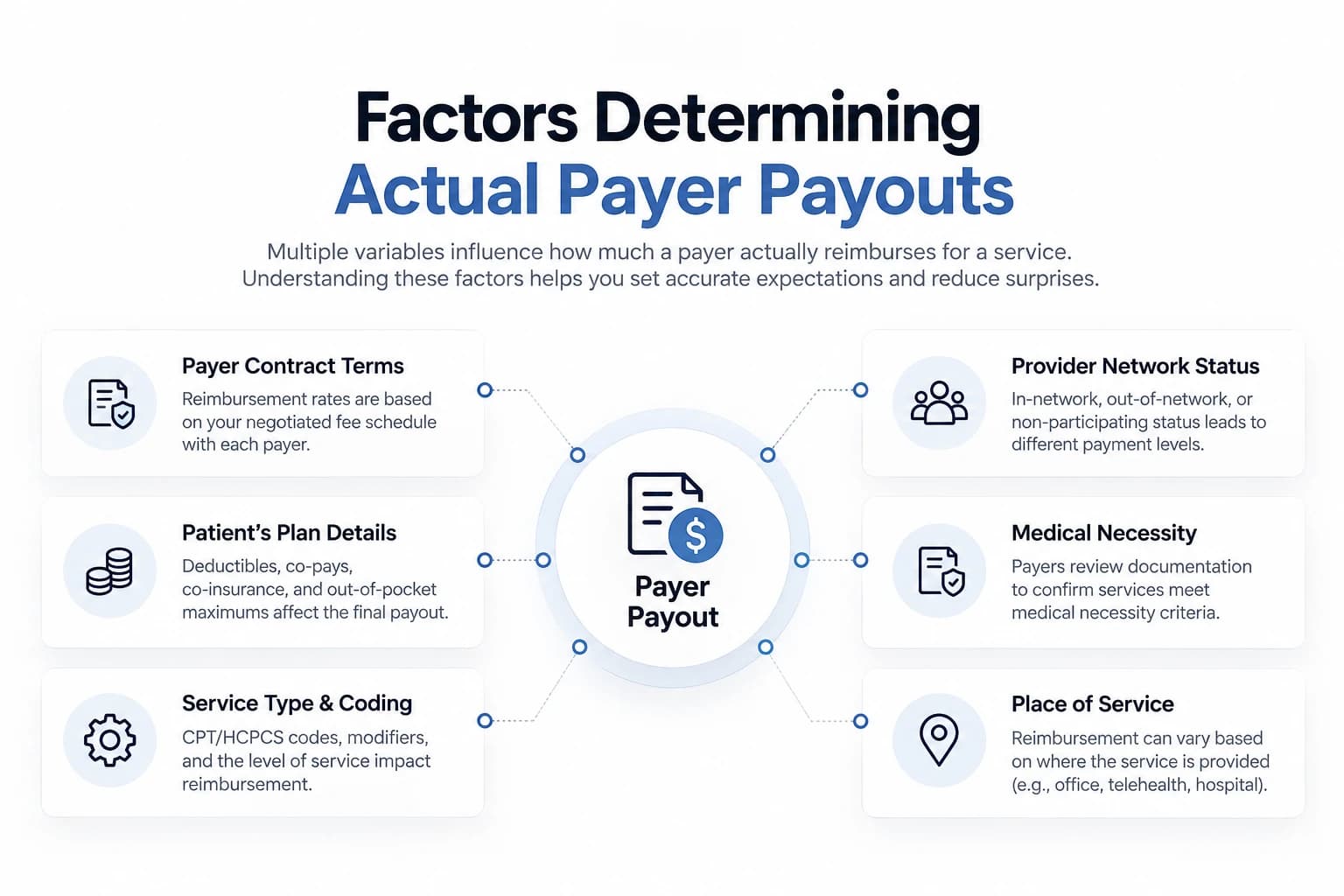
Factors Determining Actual Payer Payouts
- Geographic Practice Cost Index (GPCI): CMS adjusts reimbursement according to local operating expenses. A practice in Manhattan receives higher allowable rates than a rural clinic in Arkansas for the exact same CPT code.
- Provider License Type: Medical doctors and clinical psychologists often receive higher reimbursement schedules than licensed clinical social workers (LCSWs) or licensed professional counselors (LPCs), depending on state regulations and payer contracts.
- Commercial Payer Fee Schedules: Commercial insurance contracts are negotiated individually. Some pay rates pegged at 110% to 130% of Medicare rates, while others pay significantly less.
08
5 Critical Billing Mistakes Mental Health Practices Must Avoid
Behavioral health billing errors usually stem from administrative habits rather than deliberate non-compliance. Here are the five most common pitfalls:
Common Billing Traps:
- 1. Billing by scheduled calendar block instead of actual face-to-face duration.
- 2. Blanket billing 90837 for all patients regardless of clinical documentation.
- 3. Submitting 90832 for sessions lasting less than 16 minutes.
- 4. Using psychotherapy codes for diagnostic intakes instead of 90791/90792.
- 5. Missing required telehealth modifiers (Modifier 95) on virtual sessions.
1. Billing by Calendar Block Rather Than Actual Time
If an appointment is scheduled from 2:00 PM to 3:00 PM, but the patient arrives late and direct therapy runs from 2:12 PM to 3:00 PM (48 minutes total), the correct code is 90834. Submitting 90837 based on the calendar block constitutes improper billing.
2. Blanket Billing 90837
Defaulting every single appointment to 90837 to maximize revenue invites payer audits. Payers compare your code distribution against regional averages using National Correct Coding Initiative (NCCI) benchmarks. When your distribution deviates drastically from peer norms without clinical justification, pre-payment reviews follow.
3. Billing Sessions Under 16 Minutes
CPT rules require at least 16 minutes of direct therapy to bill 90832. If a patient leaves after 12 minutes, you cannot bill an individual psychotherapy code.
4. Confusing Diagnostic Intakes with Psychotherapy
An initial diagnostic evaluation must be billed using CPT 90791 (psychiatric diagnostic evaluation without medical services) or 90792 (with medical services). Submitting 90834 or 90837 for an initial intake assessment causes immediate claim rejections.
5. Omitting Telehealth Modifiers
Virtual sessions require appropriate modifiers and place-of-service (POS) codes. Most commercial payers and Medicare require Modifier 95 along with POS 02 (telehealth provided other than in patient’s home) or POS 10 (telehealth provided in patient’s home). Refer to the official CMS Telehealth Guidelines to verify your current billing structure.
09
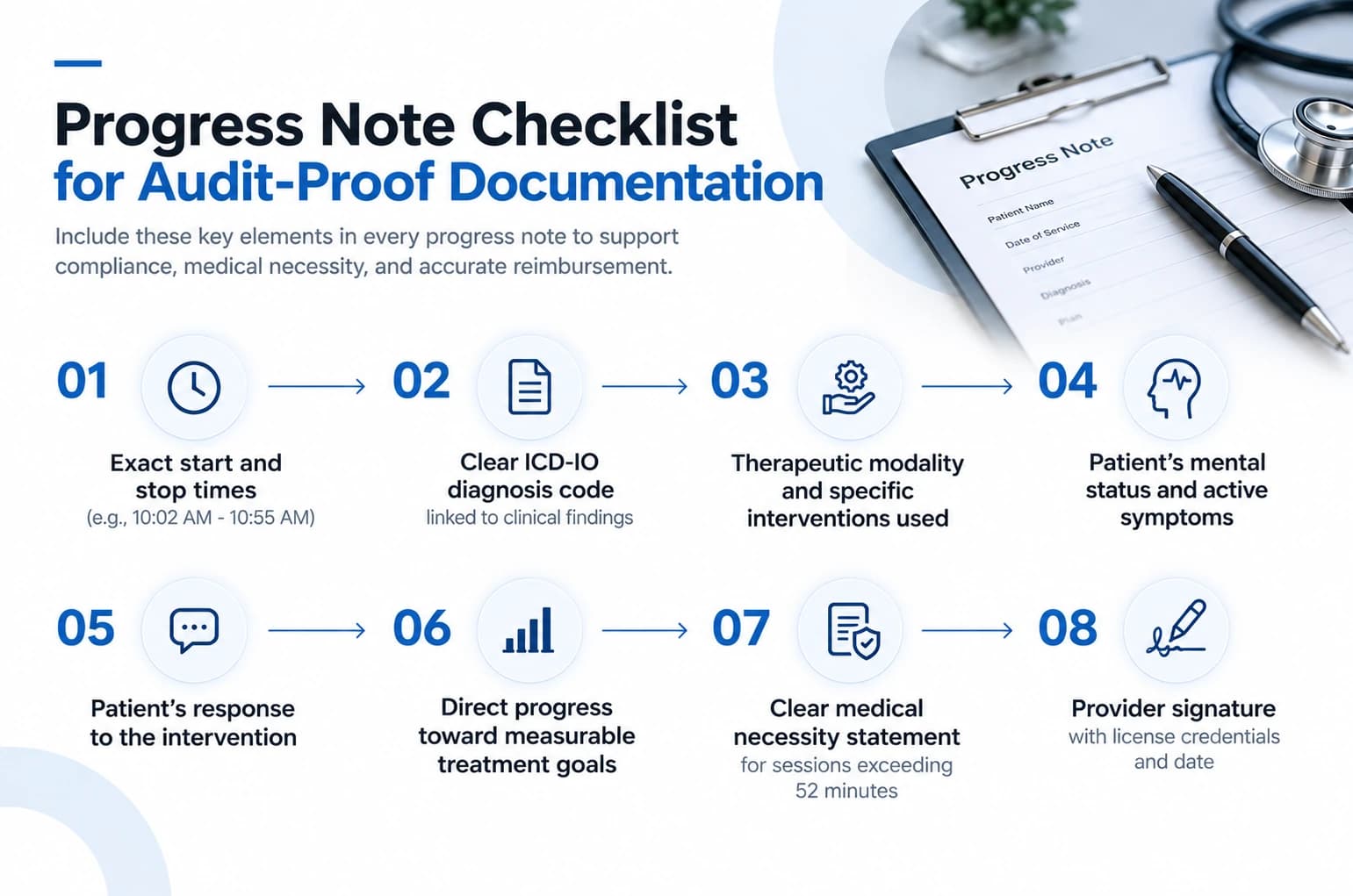
Progress Note Checklist for Audit-Proof Documentation
Every clinical note supporting 90832, 90834, or 90837 should include the following core items:
- Exact start and stop times (e.g., 10:02 AM - 10:55 AM)
- Clear ICD-10 diagnosis code linked to clinical findings
- Therapeutic modality and specific interventions used
- Patient’s mental status and active symptoms
- Patient’s response to the intervention
- Direct progress toward measurable treatment goals
- Clear medical necessity statement for sessions exceeding 52 minutes
- Provider signature with license credentials and date

The diagnostic framework should align with the current DSM-5-TR diagnostic criteria, properly translated to standard ICD-10-CM codes on the CMS-1500 claim form.
10
Essential Add-On Codes and Telehealth Modifiers
In complex clinical scenarios, standalone psychotherapy codes do not capture the full scope of care. The AMA provides specific add-on codes to reflect combined medical and psychiatric work.
| Add-On Code | Service Description | Primary Code It Pairs With |
|---|---|---|
| +90785 | Interactive complexity (interpreters, play therapy, high-reactivity family meetings) | 90832, 90834, 90837, 90791 |
| +90833 | Psychotherapy add-on, 30 min (performed with E/M service) | Evaluation & Management (e.g., 99213, 99214) |
| +90836 | Psychotherapy add-on, 45 min (performed with E/M service) | Evaluation & Management (e.g., 99213, 99214) |
| +90838 | Psychotherapy add-on, 60 min (performed with E/M service) | Evaluation & Management (e.g., 99213, 99214) |
Important distinction: Add-on codes (+90833, +90836, +90838) can never be billed alone. They are designated for psychiatrists, psychiatric nurse practitioners, or physician assistants who perform a medical evaluation and management service alongside talk therapy during the same visit.
11
Final Thoughts
Mastering psychotherapy CPT codes is essential to maintaining financial stability in mental health practice. Billing the right code protects your clinic from costly audit recoupments while making sure you are paid fully for the clinical time you provide.
Log exact face-to-face start and stop times, match your codes to established midpoint thresholds, detail your interventions thoroughly, and avoid the habit of undercoding out of fear.
Take the Confusion Out of Behavioral Health Billing
Managing client care while keeping up with changing CPT codes, modifiers, and payer authorizations is an exhausting balancing act. DastifyBH takes the entire billing workflow off your plate, optimizing your coding accuracy, appealing wrongful denials, and accelerating reimbursement.
Schedule a Consultation with DastifyBHFAQ’s
Frequently Asked Questions
Bill 90834. The 90837 code starts strictly at 53 minutes. Even a single minute matters when payer audits compare clinical records against billed CPT codes.